




A cherry picker, also known as a boom lift or aerial work platform (AWP), is an essential tool for safely reaching high places. They are widely used in orchard harvesting, building maintenance, construction, and tree care. Compared to ladders or scaffolding, a cherry picker provides greater safety, stability, and efficiency.
While users often search for “how high can a cherry picker go?”, the real purchasing decision should be based on:
“What working height and working range do I actually need on site?”
1. Platform Height vs Working Height (Critical Difference)
Always distinguish between:
Platform height = height of the basket floor
Working height = platform height + operator reach (≈ +2 m / 6 ft)
Example:
A 16 m platform height machine provides approximately an 18 m working height
This means users should always plan based on working height, not platform height, to avoid underestimating reach requirements.
2. Always Include Height Safety Margin (Do Not Select at Limit)
A common mistake is choosing a machine that only just reaches the target height.
In real applications, you should always leave a margin:
Recommended buffer: +2–3 m (6–10 ft)
Reasons:
Avoid operating at full extension (safer and more stable)
Adapt to uneven ground or positioning error
Improve operator comfort and productivity
Example:
If your job requires 18 m working height, a safer choice is typically a 20–22 m class machine
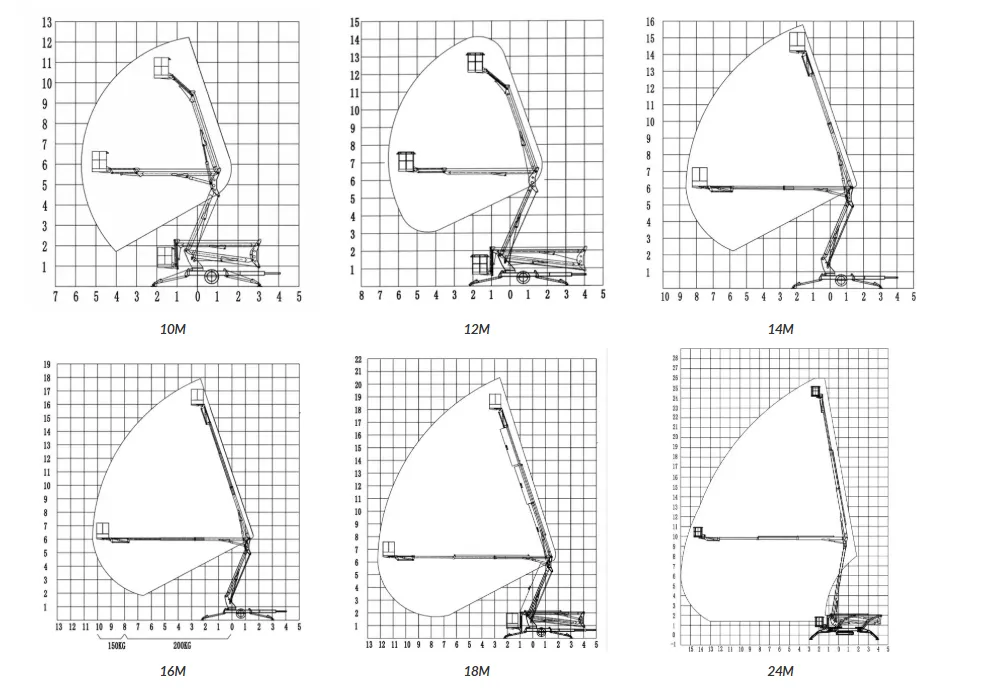
3. Horizontal Outreach Matters at Height (Working Radius)
Height alone does not guarantee efficiency.
In many applications such as orchards, façade maintenance, or steel structure work, operators must also reach sideways without repositioning the machine.
This is where working radius becomes critical.
Orchard work: reach outer branches without moving base
Construction: access walls, beams, or over obstacles
⚠️ Important relationship:
As working height increases, available horizontal outreach usually decreases to maintain stability.
Therefore, manufacturers provide a working envelope (height vs outreach chart) that should always be checked before selection.
4. Match Machine Type to Height + Movement Requirements
Articulating boom lift (knuckle boom)
- Better for obstacle clearance
- Ideal when side reach at height is required
- Suitable for orchards and complex structures
Telescopic boom lift (straight boom)
- Maximum vertical reach
- Best for open areas and high-rise construction
- More limited obstacle-avoidance capability
5. Practical Selection Logic (Simplified Rule)
When choosing a cherry picker, evaluate in this order:
- Required working height (not platform height)
- Required horizontal reach at height
- Add 2–3 m safety margin
- Check ground conditions and load requirements
- Then choose boom type and model size
- Factors Affecting Maximum Height (continued)
Additional constraints still apply:
Ground stability
Load capacity
Safety certification limits
Machine structure (articulating vs telescopic)
All operations must strictly follow manufacturer-rated working envelopes.
Aerial Work Platform Safety Guidelines
Since cherry pickers are used at great heights, safety is critical. Follow these best practices:
- Operators must receive training and certification
- Wear personal protective equipment (PPE) such as helmets and harnesses
- Conduct regular equipment inspections before operation
- Avoid use in high winds or storms
- Set up safety barriers to restrict access to the work area
- Follow all manufacturer load and height limits
By prioritizing safety, you reduce accident risks and ensure smooth operations at height.
Looking for a reliable cherry picker? Contact LEMAX engineers today for customized solutions on height, boom lift working radius, and load capacity to fit your exact needs.