





Working safely and efficiently at height requires not just the right training and planning — it requires the right cherry picker. In industrial maintenance, construction, warehousing, and facility management, choosing the proper aerial work platform (AWP) directly affects productivity, safety, and operational cost.
This technical guide provides a complete framework for evaluating, selecting, and deploying cherry pickers and mobile elevated work platforms (MEWPs).
1.What is a Cherry Picker?
A cherry picker is a type of boom lift designed to lift personnel, tools, and materials to elevated or hard-to-reach work areas. The platform, mounted at the end of a hydraulic arm, provides vertical and horizontal outreach for safe aerial access.
1.1 Historical background
Originally designed for fruit picking — hence the name “cherry picker” — these machines evolved into industrial lifting systems used in:
- Electrical maintenance and overhead wiring
- Window cleaning and facade repair
- Construction, painting, and cladding
- Tree trimming and landscaping
- Film and photography setups
- Warehouse and logistics operations
1.2 Classification under MEWP standards
According to ISO 16368 and EN 280, cherry pickers belong to the boom-type MEWP category. They differ from scissor lifts in that they offer lateral outreach, not just vertical elevation.
2.What are the Different Types of Cherry Pickers?
Selecting the correct model begins with understanding the mechanical configurations available. Each type has unique motion characteristics, weight limits, and operating environments.
2.1 Telescopic Boom Lifts (Straight Boom)
Telescopic booms — sometimes called “stick booms” — extend linearly using overlapping sections.
Key features:
- Exceptional Vertical Reach, often 20 m – 40 m
- Precise control and stability at height
- Ideal for open, outdoor sites such as shipyards, refineries, and steel structures
- Capable of working at full outreach without jibs or joints
Technical note: The outreach-to-height ratio for modern telescopic booms is approximately 0.85 : 1, meaning a 40 m machine may reach 34 m horizontally.
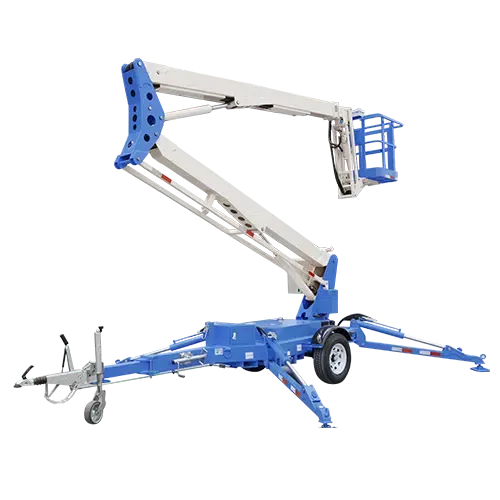
2.2 Articulating Boom Lifts (Knuckle Boom)
Articulating booms consist of several hinged sections (“knuckles”) that allow movement around obstacles.
Advantages:
- Excellent maneuverability for congested environments
- Ability to reach up and over roofs, ducts, and machinery
- Compact storage and lower stowed height
- Available in electric, diesel, and bi-fuel versions
- Typical working height: 10 m – 26 m.
These machines dominate indoor and urban applications where access paths are limited.
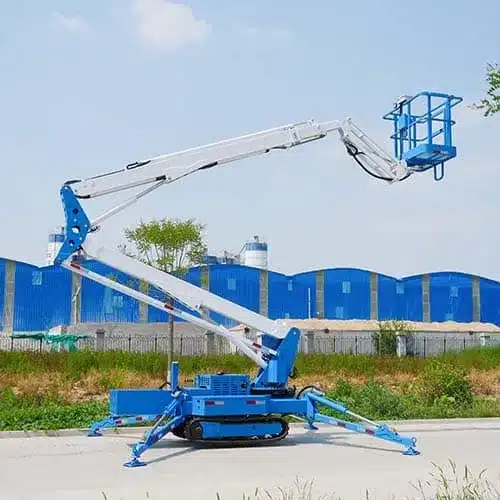
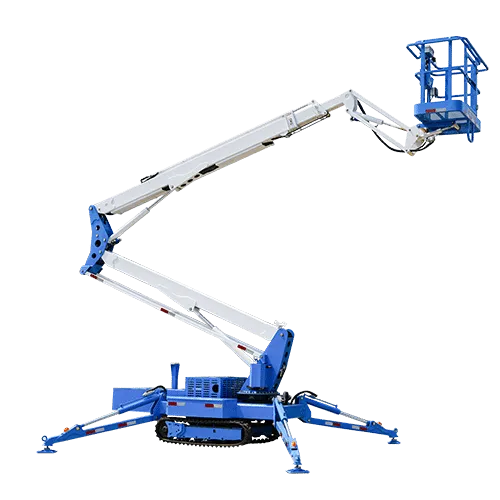
2.3 Spider Lifts (Tracked or Crawler Boom)
Spider lifts combine a telescopic or articulated boom with outriggers and rubber tracks.
They are engineered for lightweight operation on delicate or uneven surfaces.
Applications include:
- Atriums, shopping centers, churches, and airports
- Landscaping and arboriculture
- Facilities with narrow doors or weight restrictions
Despite compact dimensions, some spider lifts reach up to 40 m working height while weighing under 5 tons — a significant advantage over conventional diesel booms.
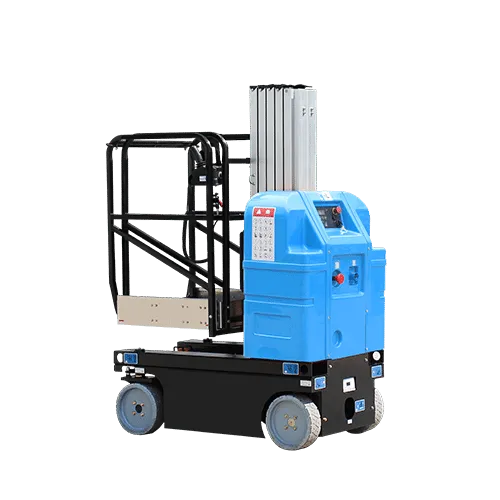
2.4 Mast Boom Lifts (Vertical Mast Lifts)
Mast booms use a telescoping vertical mast and small jib for outreach.
Advantages:
- Tight turning radius and small footprint
- Ideal for indoor maintenance, lighting, and shelving work
- Zero-emission operation in electric models
Typical lift range: 6 m – 12 m working height, 200 kg platform capacity.
3. Cherry Picker vs Boom Lift vs Scissor Lift
The terms are often used interchangeably, but technical differences are important.
Equipment Type Motion Type Typical Application Outreach Capability
Cherry Picker / Boom Lift Vertical + horizontal Building maintenance, construction –Yes
Scissor Lift Vertical only Indoor fit-outs, warehouses –No
Aerial Work Platform (AWP) Generic term covering all MEWPs — —
If your job requires reaching over or around obstacles, only a boom-type cherry picker provides that flexibility.
4. Technical Parameters That Matter Most
When specifying a cherry picker, engineers and safety managers should evaluate the following core parameters:
- Working Height (WH) – Maximum height from ground to platform floor.
- Platform Capacity (SWL) – Safe Working Load including operator(s) and tools.
- Horizontal Outreach (HO) – Distance from center of rotation to basket edge at full extension.
- Up-and-Over Clearance – Maximum vertical obstacle the boom can clear.
- Machine Width & Turning Radius – Determines access feasibility.
- Gradeability / Rough-terrain Rating – Expressed as %, typically 25 – 40 %.
- Power Source – Diesel, electric, bi-fuel, or hybrid.
- Weight & Ground Pressure – Key for flooring load analysis.
- Stowed Height & Length – For transport and storage logistics.
A structured evaluation matrix helps align these parameters with jobsite conditions and safety standards.
5. Power and Drive Systems
The choice of power system determines where and how efficiently the machine can operate.
5.1 Diesel Cherry Pickers
- High torque, ideal for outdoor and rough-terrain work.
- Often equipped with 4WD and oscillating axles.
- Noise and emissions must comply with local regulations (e.g., EU Stage V).
5.2 Electric Cherry Pickers
- Zero tailpipe emissions and minimal noise.
- Excellent for indoor environments or low-ventilation areas.
- Use deep-cycle lead-acid or lithium-ion batteries.
- Require charging infrastructure and battery maintenance.
5.3 Bi-Fuel / Hybrid Systems
- Combine an electric drive with a diesel generator.
- Provide extended operation hours and flexibility.
- Automatic switching minimizes downtime.
For sustainability targets (ISO 14001 compliance), many fleets are transitioning to electric and hybrid MEWPs.
6. Stability and Load Safety
Machine stability is determined by the combined effect of boom geometry, center of gravity, and ground contact area.
6.1 Stability control systems
Modern booms integrate:
- Tilt sensors and automatic interlocks
- Load-sensing systems (LSS) that cut motion when overloaded
- Platform control redundancy for emergency lowering
6.2 Ground assessment
Before deployment, operators should verify:
- Surface bearing capacity (kN/m²)
- Gradient and drainage conditions
- Proximity to underground services
Following EN 280 requirements, all MEWPs must maintain a 1.3 safety factor against overturning.
7. Cherry Picker Selection Process
A systematic selection method ensures the right balance between capability, safety, and cost.
Step 1 — Define Working Requirements
- Maximum height and outreach
- Number of operators and equipment weight
- Indoor vs outdoor environment
- Duration and frequency of use
Step 2 — Assess Site Constraints
- Floor loading limit
- Access width/door clearance
- Presence of obstacles or overhead power lines
- Noise and emission restrictions
Step 3 — Match Power Source and Drive Type
- Electric for indoor and clean areas
- Diesel for open, heavy-duty environments
- Bi-fuel for mixed applications
Step 4 — Verify Technical Compliance
Ensure conformity with:
- EN 280:2013 +A1:2015 (European standard for MEWPs)
- ANSI A92.20 (North American equivalent)
- Local site-specific risk assessments
Step 5 — Perform Cost–Benefit Analysis
- Consider: equipment hire vs purchase, maintenance, fuel cost, operator training, and insurance.
8. Safety Regulations and Operator Training
Operating a cherry picker without proper certification is both unsafe and non-compliant.
8.1 Regulatory bodies
The International Powered Access Federation (IPAF) sets global standards for operator training and machine safety.
Relevant categories include:
1b — Static boom (trailer or truck mounted)
3b — Self-propelled boom
8.2 Training outcomes
Certified operators receive the Powered Access Licence (PAL Card), valid for five years, confirming competence in:
- Pre-use inspection
- Emergency descent procedures
- Safe platform operation
8.3 PPE and fall protection
Operators must wear:
- Full-body safety harness
- Adjustable lanyard fixed to the anchor point
- Helmet with chin strap
- Non-slip footwear
8.4 Daily pre-use checklist
- Hydraulic leaks or damage
- Tire condition and pressure
- Emergency stop operation
- Guardrails and gate locks
- Boom and basket articulation range
- Battery charge or fuel level
9. Environmental and Sustainability Considerations
The industry is rapidly transitioning toward low-emission and energy-efficient MEWPs.
9.1 Battery technology
Lithium-ion packs reduce weight by up to 25 % and allow fast charging.
Smart BMS (Battery Management Systems) optimize life cycles, reducing total ownership cost.
9.2 Noise and emission standards
For indoor or urban projects, compliance with local dB limits (< 75 dB @ 7 m) is crucial.
Electric cherry pickers naturally meet these criteria.
9.3 Recyclability and design
Modern manufacturers employ high-strength low-alloy (HSLA) steel and powder-coating for durability and recyclability.
9.4 Carbon accounting
Fleet managers increasingly calculate CO₂ emissions per operating hour.
Transitioning to electric or hybrid platforms can reduce emissions by up to 60 % compared with diesel equivalents.
10. Maintenance and Lifecycle Management
A cherry picker’s reliability depends on a proactive maintenance regime.
10.1 Preventive maintenance schedule
- Daily: visual inspection and function test
- Weekly: lubrication, hydraulic check
- Quarterly: battery or fuel system maintenance
- Annually: full service, safety system recalibration
10.2 Common failure points
- Hydraulic hoses and fittings
- Boom wear pads
- Control joystick sensors
- Battery terminals and connectors
10.3 Record keeping
- Maintain service logs and inspection certificates.
- Digital fleet management systems can automate reminders and compliance tracking.
11. Hire vs Buy: Economic Considerations
11.1 When to hire
- Occasional or seasonal usage
- Short-term projects
- Limited storage or transport capacity
- Rapid access to various models
- Benefits: predictable cost, maintenance included, and immediate availability.
11.2 When to buy
- Frequent, long-term use
- Specialized operations requiring customization
- In-house maintenance capability
- Perform a Total Cost of Ownership (TCO) analysis considering depreciation, insurance, and residual value.
For many medium-sized contractors, a hybrid strategy — core fleet ownership plus short-term rentals — yields optimal flexibility.
12. Conclusion
Choosing the right cherry picker is not simply about height — it’s about matching machine performance to task parameters while ensuring regulatory compliance and operator safety.
By analyzing:
- Work height and outreach
- Ground and site conditions
- Power source and drive system
- Load capacity and stability
- Operational frequency and budget
- …you can determine the most efficient and safest aerial access solution for your organization.
A data-driven, standards-based approach not only prevents costly downtime but also ensures compliance with global MEWP regulations, helping your projects reach new heights — literally and figuratively.
Get Expert Advice
If you’re not sure which cherry picker is right for your job, our technical team can help you evaluate working height, outreach, and ground conditions to recommend the most suitable model.
Contact LEMAX today to get professional guidance and a competitive quotation for your next project.